
Written by / Researcher Yi-Chun Chen
Formulating Research Directions to Uncover Potential Problems in the Current Situation
Around 2020, the Taiwan Design Research Institute conducted a public service transformation project for public health centers. Located in New Taipei City, which has a population exceeding 4 million, user interviews and questionnaire tests were conducted both before and after adjustments to the services.
Taiwan's current community health outposts are the public health centers within each administrative district, representing the most direct health channel facing the public. Concurrently, they must execute various tasks for national and local governments, including cancer screenings, health education, adult and infant vaccine administrations, mental health cases, and domestic violence issues. The services they work on are considerably complex, making it difficult to focus on strategy formulation, which poses substantial challenges to implementing service design.
New Taipei City spans across both urban and rural areas, meaning that even within the same administrative region, the services of public health centers can be completely different due to environmental variations. They are not only influenced by demographic variables, geographic locations, and service volumes, but also show differences in family economic statuses and health literacy performances. Based on recommendations from policymakers, we prioritized the improvement of the new-township-type Xizhi District Public Health Center and the rural-township-type Yingge District Public Health Center.

Figure 1: Types of Public Health Centers in New Taipei City
Defining Problems with Design Thinking Methods
First, the research team reconstructed the actual scene of the public health centers, including pain points invisible to managers and service processes misunderstood by users. Through data collection, field observations, surveys, and interviews, they understood the actual context and tacit knowledge, establishing a fundamental argument for subsequent co-creation with stakeholders.
To understand the public's established impressions of public health centers and to propose data that local government health departments could believe, we considered that "design thinking" leans toward the perspective of "optimization" to evaluate viable strategies. Therefore, the focus was placed on analyzing the public's service experiences with public health centers rather than just the traditional survey metric of "satisfaction." Simultaneously, we planned to incorporate the public's service awareness and utilization rates of public health centers, attempting to restore the profile and characteristics of the health centers.
In addition to survey questionnaires, the actual condition of the service field is another major key point. Taking vaccine administration services as an example, the team mapped out the users' journey maps and their indoor movement flows at the health centers. From an observer's perspective, they observed the users' experience process during the service flow, recording details such as service items, service routes, usage methods, and environmental configurations, and drew customer journey maps to identify service process gaps and propose movement adjustment suggestions.

Figure 2: Public Health Center Service Analysis
Introducing Service Design into the Design and Planning of Public Health Centers
Good service creation encapsulates the manager's commitment and value to users, which is the "value proposition." However, "value delivery" is often difficult and frequently dilutes gradually under busy operations and field management. Therefore, from a service design perspective, reshaping an effective service must not only satisfy users but also benefit service providers and make management easier. It is a two-way delivery of value that can effectively drive service transformation.
Consequently, the research team compiled through interviews the values that 6 public health center managers believe are currently provided and the "values" that should be emphasized in the future (from Maslow's theory). Preliminary research results revealed that both now and in the future, "health promotion" remains the consistent value delivered by health centers, currently utilizing various "delivery channels" to enhance health literacy. In the future, while satisfying health promotion, they hope to develop better "service quality" and "design aesthetics," turning the health center into a "brand."
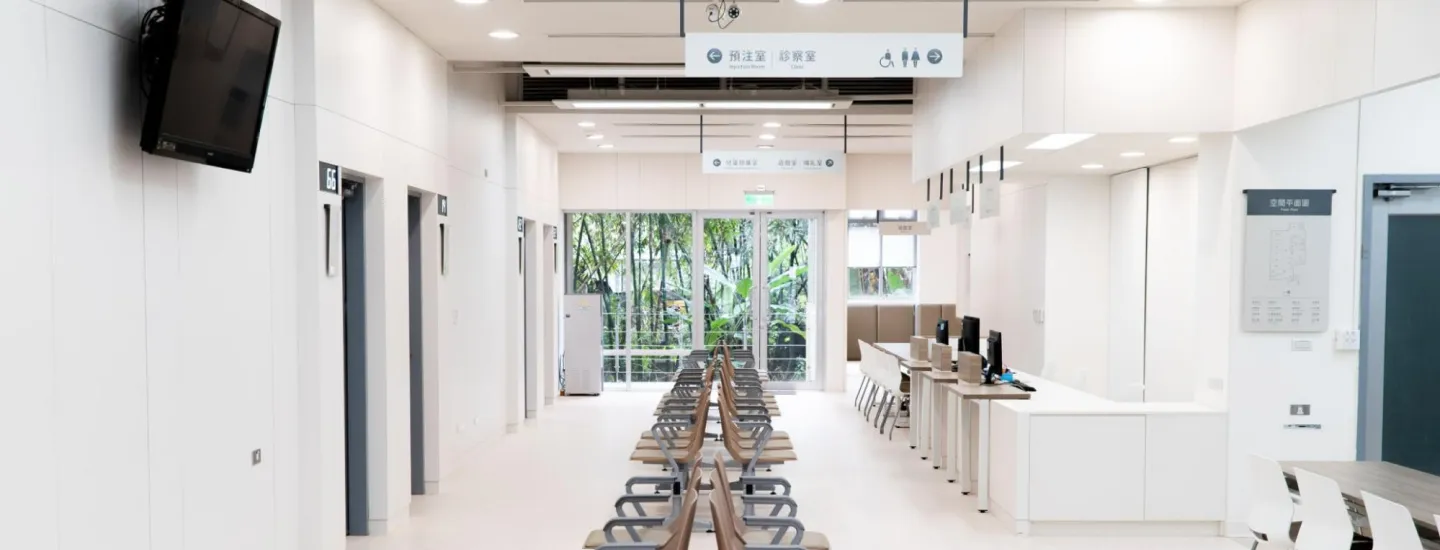
Based on these results, we subsequently proposed a complete design plan to the Department of Health of New Taipei City, including adjustments to service processes, movement flows, partitions, and guidance sign graphics, as well as altering the working habits of the staff, such as establishing self-service writing counters and labeling clear waiting times. Furthermore, according to regional characteristics, parent-child play areas were set up, and spaces for classrooms and gyms were increased, attempting to change the public impression that these are merely places for vaccinations. Ultimately, the city government agreed with and adopted these design directions, launching improvement operations for the two public health centers (located in Xizhi District and Yingge District).

Figure 3: Health Center Design Recommendations