
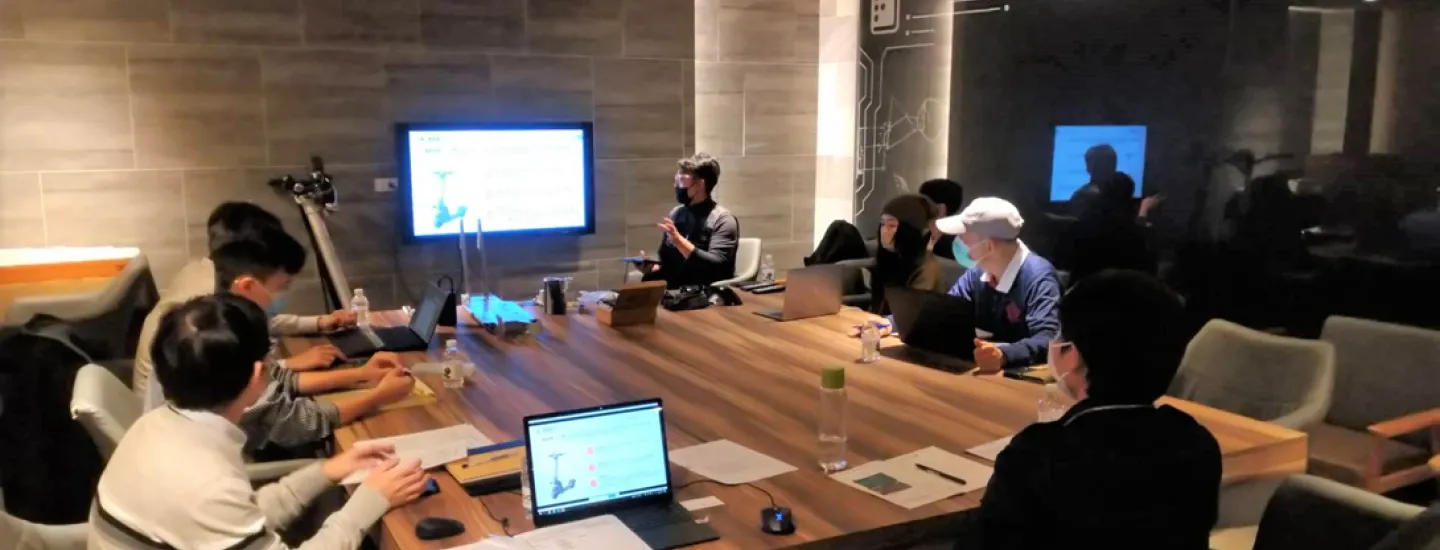
Written by / Researcher Cheng-Che Hung
Background Introduction
In 2021, McKinsey, a world-renowned consulting firm, pointed out in its research on future mobility that the global market size of scooters might reach 300 to 500 billion USD within 10 years. Electric scooters, as an example of micromobility, not only save the time people spend in traffic congestion but also avoid the trouble of looking for parking spaces. Shared riding targets the commuting group traveling under 8 kilometers, supplementing the last mile of mobility within the transportation system. Internationally, Bird and Lime, founded in 2017, achieved unicorn status within a short period, and Singapore and Tokyo also have electric scooter startups Beam and Luup providing services. From this, it can be seen that the trend of using electric scooters as light mobility vehicles or replacing the public transportation service system is highly distinct across the world, especially at present during the pandemic when everyone moves separately. As for why it is electric scooters? Lightweight, convenient, easy to store, and of course, it is also very cool!
Looplus Service Technology Inc. (oloo) started from software and takes reversing rigid urban mobility as its primary vision, being the first and only shared electric scooter service provider in Taiwan. Although electric scooters are currently still restricted by regulations and cannot possess road rights on general roads—thus can only be introduced and applied within specific activity boundaries—the rental services provided by oloo have already landed in three campus fields: National Yang Ming Chiao Tung University (two campuses) and National Central University, truly bringing the shared electric scooter model into Taiwan. However, the factors that need to be considered when operating as a rental service are far more numerous than selling a single electric scooter. It requires not only a lean management system and a customer-friendly APP, but the rapid depreciation of scooter bodies, the stability of spare parts, and the time costs required during maintenance also increase drastically along with the rise in the number of deployed vehicles. According to investigations, over 90% of the supply sources for scooters of large and small operators in various countries come from China, which are self-assembled into whole vehicles via different components before white-labeling, with only a few large manufacturers establishing plants to develop their own brand vehicles. This approach, due to uneven component quality, not only leads to unknown malfunctions easily because of poor compatibility, but also affects service quality and oloo's corporate reputation due to safety concerns.
Therefore, oloo decided to co-create and introduce design with Rider. Simultaneously taking three roles—the riding customers, the maintenance personnel, and the operations team—as users, they transformed their needs into electric scooter specifications to produce a Made-in-Taiwan electric scooter specifically designed for the shared industry. This provides durable and reassuring electric scooter products, reduces the workload and industrial injury risks of maintenance personnel, and enhances work efficiency.
Design Research Introduction
In addition to its own design background, Rider possesses rich experience in the distribution, retail, and maintenance services of high-quality electric vehicles, frequently standing at the front line of the industry, and thus possesses sufficient domain knowledge to assist oloo in completing the Made-in-Taiwan electric scooter product. Facing challenges coming simultaneously from customers, maintenance personnel, and the operations team this time, four distinct phases of approaches were primarily adopted: (1) Discover: Uncover existing product usage scenarios through deep user research; (2) Define: Transform needs and improve user dilemmas; (3) Develop: Build sample prototypes and test usage through systematic structural design; (4) Deliver: Collect user feedback and then input into improvements.
-
Discover
With the objective of simultaneously satisfying the needs of three parties, the first step was to confirm whose problems to solve, so that a solution maximizing the alignment of interests among various groups could be found through design. Rider and oloo turned the spotlight onto frontline employees (maintainers) and general users (consumers). Through the think-aloud method (in-depth interviews, task execution, simultaneous observation, and real-time recording), they obtained data from eight frontline employees and six general users, while the operations team served the “gate” role to evaluate the feasibility and profitability of improving scenarios.
By utilizing the data collected in this phase, a matrix approach was used to focus on user needs from different stances and vehicle body components that might affect specifications, forming a relatively rough framework before beginning to define the detailed content.
-
Define
The discover phase only stopped at categorizing key issue scopes such as pedal size, product appearance, and weight, and next was the time when professional industry domain knowledge was required. The team re-pondered the collected key issues and ensured that members' conceptual ideas remained consistent during the process through continuous sketch drawing and modifications. This section ultimately took swappable batteries, modular parts, and high-strength structures as strategic guidelines, establishing a detailed concept for a rental-use electric scooter.
-
Development
With the objective of producing product prototypes, after establishing detailed concepts, it was also inevitably necessary to transform sketches into 3D structures and 3D appearances. Simultaneously, there was the search for manufacturers in Taiwan capable of manufacturing or even opening molds for the required parts. "After we practically started developing, we realized that our understanding of the supply chain had to be further deepened. The part costs increasing by twenty to thirty percent is one thing, but some things originally envisioned were simply not provided by anyone," stated Chih-chia Lin, General Manager of oloo.
-
Deliver
In any case, the new model oloo SS would first be sampled by Gold Industrial under existing conditional limitations. The sample prototype would return to the development phase for iterative corrections after practical testing. Observing according to the current status, an electric scooter featuring a larger standing space, comfortable posture, less vibration, and more convenience for carrying would appear in 2023.
Outcome Illustration
This "Shared Electric Scooter - Design and Manufacture MIT Project" of oloo is both an expectation for Taiwan's future development of the electric micromobility industry and a classic demonstration of opening up open innovation together with Rider. Open innovation is an innovation model that accelerates internal innovation through purposeful inflows and outflows of knowledge, and utilizes external innovation to expand markets, which can help enterprises break the boundaries between themselves and the surrounding environment.
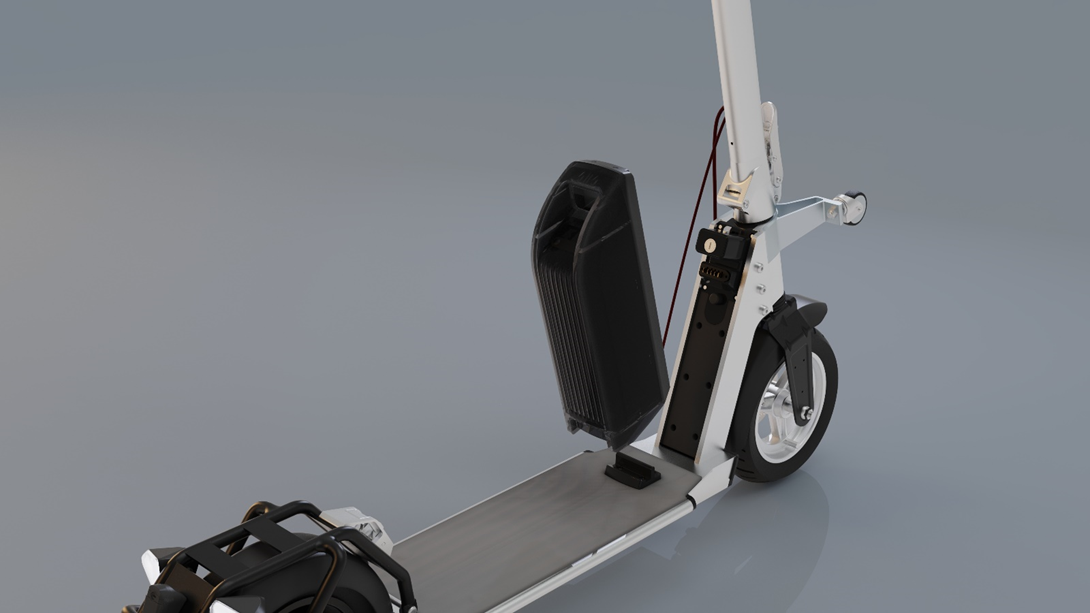
Figure 1: Electric Scooter Design Outcome
In the consensus of the project team, experience is the direction in which products should develop. An all-Taiwanese-made rental electric scooter that simultaneously solves the pain points of three parties is not only about to be used on campuses in 2023, but the localized significance of the supply chain contained within cannot be ignored, possessing representative significance for Taiwan's industrial ecosystem; let us wait and see the actual product deployment.
With Rider’s knowledge and experience regarding high-quality electric vehicles joining in, "not only was the convergence of needs very fast during early discussions, but results were also reached quickly for some problems originally expected to take time to solve," General Manager Chih-chia Lin was quite surprised.
Kai-fu Cheng, founder of Rider, stated, "oloo's value proposition and target market were distinct right from the beginning. This requires excellent company leaders to set up strategies this way, which consequently reduced a lot of time spent on repeated verifications." In observation, this can serve as a very good demonstration of value co-creation.
References:
Outcomes of the "Design-Driven Technology R&D and Industry–Research Co-Creation Program” executed by the Taiwan Design Research Institute for the Department of Industrial Technology, Ministry of Economic Affairs in 2022.